


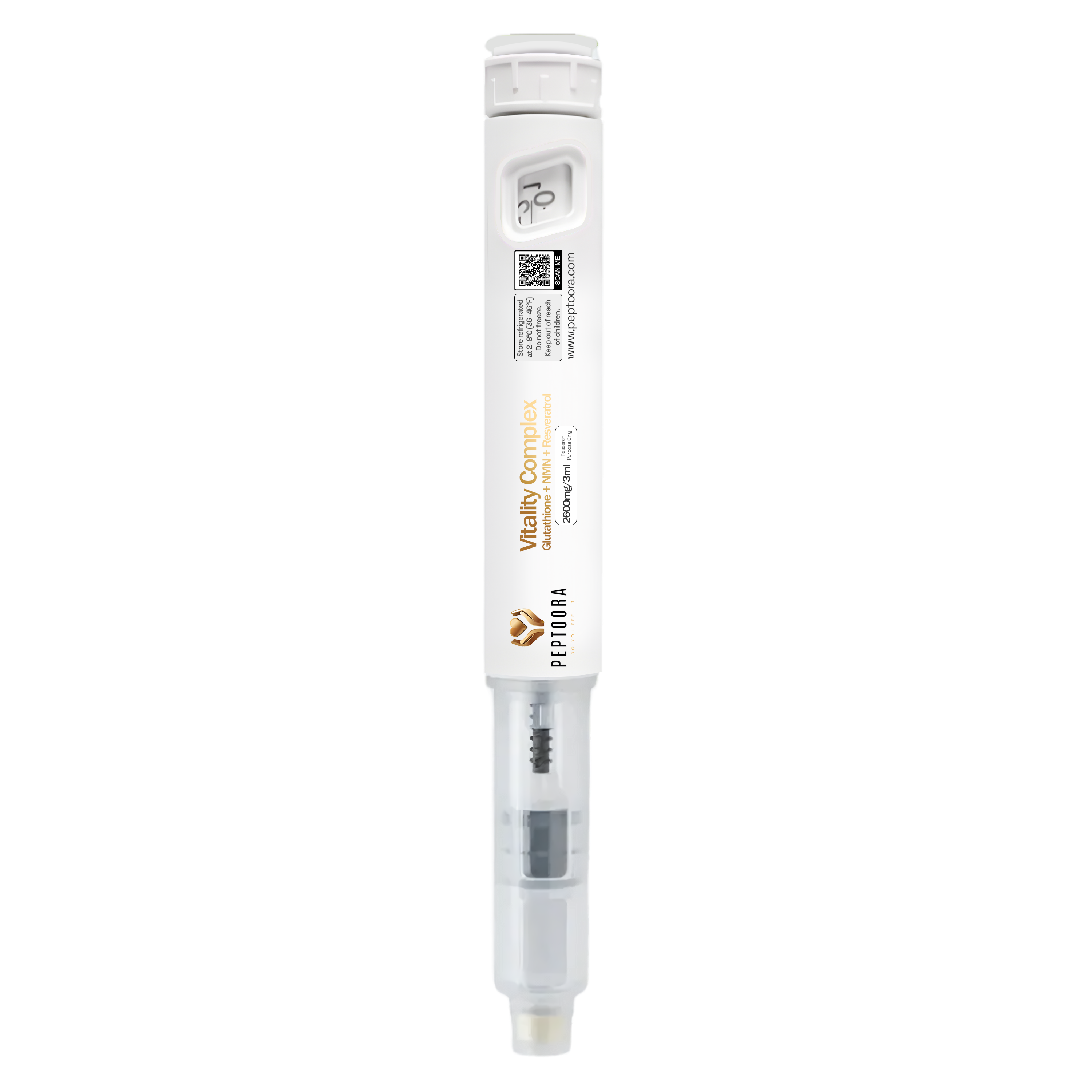
Vitality Complex (Glutathione, NMN & Resveratrol) | Pen
Vitality Complex (Glutathione, NMN & Resveratrol) is a blend positioned for controlled research settings where mitochondrial function and cellular resilience is being studied in relation to redox homeostasis, NAD+-linked bioenergetics, and SIRT1-associated stress-response signaling.
Supports
- Redox balance and oxidative damage endpoints (GSH-system markers; model-dependent)
- Mitochondrial respiration efficiency readouts (OXPHOS and ATP-linked endpoints; context-dependent)
- NAD+ metabolome and turnover markers (NMN/NAD+ axis profiling; endpoint-dependent)
- Sirtuin-linked signaling proxies (SIRT1-associated transcriptional signatures; context-dependent)
- Inflammation and metabolic stress marker panels (cytokine and metabolic biomarkers; model-dependent)
Description
Vitality Complex integrates three extensively studied molecules used in experimental longevity and metabolic resilience research: glutathione (a primary intracellular redox buffer), NMN (a NAD+ precursor used to probe NAD+ availability and NAD+-dependent signaling), and resveratrol (a polyphenol often investigated in stress-response and sirtuin-adjacent pathway frameworks). The blend is designed for research protocols examining how redox balance, mitochondrial energy handling, and NAD+-linked signaling intersect in cellular aging biology.
In controlled models, glutathione-related endpoints typically focus on oxidative burden markers and antioxidant network balance, especially under metabolic or inflammatory challenge. NMN is commonly evaluated through NAD+ metabolome shifts, mitochondrial function readouts, and downstream NAD+-dependent enzyme activity proxies (e.g., sirtuin/PARP-linked endpoints). Resveratrol is frequently explored for effects on transcriptional programs associated with cellular stress adaptation, metabolic flexibility, and inflammation-related mediator profiles.
Because outcomes can vary substantially by model, baseline state, and measurement strategy, interpretation is best anchored to predefined biomarkers (redox panels, NAD+ metabolome, mitochondrial function readouts, and stress-response signatures) with appropriate controls.
Clinical Status
Each component has substantial research coverage across in vitro and animal systems, with human studies available for NMN/NAD+ biology and resveratrol biomarker outcomes in selected populations. Evidence is heterogeneous and endpoint-dependent, and the blend is positioned for research use rather than as a regulatory-approved intervention.
Evidence type:
Human RCT ✔ | Observational ✔ | Animal ✔ | In vitro ✔ | Regulatory approval ☐
Mechanism of Action
Vitality Complex is designed around three complementary mechanistic lenses. Glutathione supports redox buffering and is studied through GSH/GSSG balance, antioxidant enzyme network markers, and oxidative damage proxies. NMN is a precursor in NAD+ biosynthesis and is used to study how NAD+ availability influences mitochondrial energy metabolism and NAD+-consuming enzymes involved in DNA repair and stress-response signaling.
Resveratrol is studied as a stress-response modulator with reported interactions across multiple signaling pathways; experimental designs often focus on sirtuin-associated frameworks and downstream transcriptional signatures relevant to metabolic adaptation. In combination, these components support integrated measurement of redox status, NAD+ metabolome shifts, mitochondrial function endpoints, and stress/inflammation marker panels within controlled research paradigms.
Benefits
-
Redox homeostasis mapping:
Supports research designs quantifying oxidative burden markers and glutathione-system endpoints under stress paradigms. -
NAD+ availability and turnover endpoints:
Relevant to studies tracking NAD+ metabolome shifts and downstream NAD+-dependent signaling proxies. -
Mitochondrial bioenergetics readouts:
Supports assessment of respiration efficiency, ATP-linked endpoints, and mitochondrial stress resilience markers. -
Sirtuin-associated stress-response signatures:
Enables evaluation of transcriptional and signaling markers often used to contextualize sirtuin-linked pathway hypotheses. -
Inflammation and metabolic stress panels:
Applicable to designs measuring cytokine profiles, insulin sensitivity proxies, and lipid/glucose biomarker endpoints. -
Integrated longevity biology framework:
Provides a combined redox–NAD+–mitochondrial lens for models studying cellular aging and resilience endpoints.
Research Data
| Study/model | Reported effect |
| Human NMN supplementation trials (selected cohorts) | NAD+ metabolome shifts and functional biomarker endpoints assessed; outcomes vary by population and endpoint selection |
| Resveratrol randomized trials (metabolic endpoints) | Biomarker changes reported in some cohorts (e.g., insulin sensitivity proxies); heterogeneity by dose/formulation/population |
| Glutathione redox system models (cell/animal) | GSH/GSSG balance and oxidative damage proxies used to quantify redox buffering under oxidative challenge |
| NAD+ metabolism and aging frameworks | NAD+ decline and NAD+-dependent enzyme activity tracked as aging-linked biomarkers in controlled systems |
| PARP/sirtuin crosstalk models | NAD+ consumption by repair/signaling enzymes evaluated via activity proxies and substrate-availability endpoints |
| Mitochondrial stress paradigms (in vitro/animal) | Respiration efficiency and ROS production endpoints assessed alongside antioxidant and NAD+ pathway modulation |
| Inflammation-linked metabolic challenge models | Cytokine panels and metabolic biomarkers measured together to map resilience responses |
| Systems-level reviews of resveratrol and NAD+ biology | Mechanistic hypotheses summarized; emphasizes endpoint specificity and variability across study designs |
Stack Suggestions
In extended experimental designs, Vitality Complex (Glutathione, NMN & Resveratrol) is sometimes paired with:
- Spermidine → autophagy/mitophagy endpoint panels alongside NAD+ and redox readouts
- SS-31 (Elamipretide) → mitochondrial membrane stability and respiration endpoint expansion
- Curcumin → inflammatory mediator profiling and antioxidant-response marker panels
Stacks discussed are for experimental design only, not safety/efficacy guidance.
Possible Side Effects
No product-specific adverse-effect text was provided. In research contexts, tolerability signals can be model-dependent and may include gastrointestinal discomfort markers (often discussed with polyphenols), transient shifts in sleep or stimulation markers in sensitive models, and variability in metabolic biomarker panels depending on baseline state. Experimental designs typically emphasize conservative exposure, predefined biomarker monitoring, and discontinuation if sensitivity occurs.
Scientific References
- Glutathione! (overview of glutathione biology and redox systems) — Review
- NAD+ metabolism and the control of energy homeostasis: implications for ageing — Review
- NAD+ boosting strategies and sirtuin biology in aging research — Review
- Resveratrol improves metabolic function in obese men: a randomized, placebo-controlled trial — Human RCT
- Resveratrol and health: a comprehensive review of human clinical trials — Review
- Nicotinamide mononucleotide (NMN) randomized human trials and biomarker outcomes (PubMed search) — Human RCT
- NMN supplementation safety and tolerability in humans (PubMed search) — Observational/Human
- PARP and sirtuin crosstalk via NAD+ consumption in DNA repair and stress signaling — Review
- Oxidative stress, mitochondrial dysfunction, and aging: integrated biomarker frameworks — Review
- Resveratrol and SIRT1-associated pathway hypotheses: mechanistic reviews (PubMed search) — Review
Cautions
- For educational and scientific context only; not intended to diagnose, treat, cure, or prevent any disease.
- If you are pregnant, nursing, have a medical condition, or use prescription medication, consult a qualified professional.
- Discontinue use if sensitivity occurs.
Pairs well with
In stock! Ships within 2-6 business days.
Complimentary shipping & returns
Vitality Complex (Glutathione, NMN & Resveratrol) | Pen
FAQs
Please read our FAQs page to find out more.
Do I need a prescription to place an order?
No prescription is required to place an order. We recommend professional consultation before using any product where applicable.
Are the pens ready to use?
Our systems are designed for convenience and consistency. Product-specific handling and storage guidance is provided with each order.
Are these products intended to diagnose, treat, cure, or prevent disease?
No. Products are not intended to diagnose, treat, cure, or prevent any disease.
When will my order be shipped?
Orders are typically dispatched within 2–4 business days, subject to product availability and verification. Once shipped, delivery time depends on your destination and carrier.
How should I store products after delivery?
Store products according to the label and included guidance. Some products may require refrigeration after opening. Improper storage can impact product integrity.