


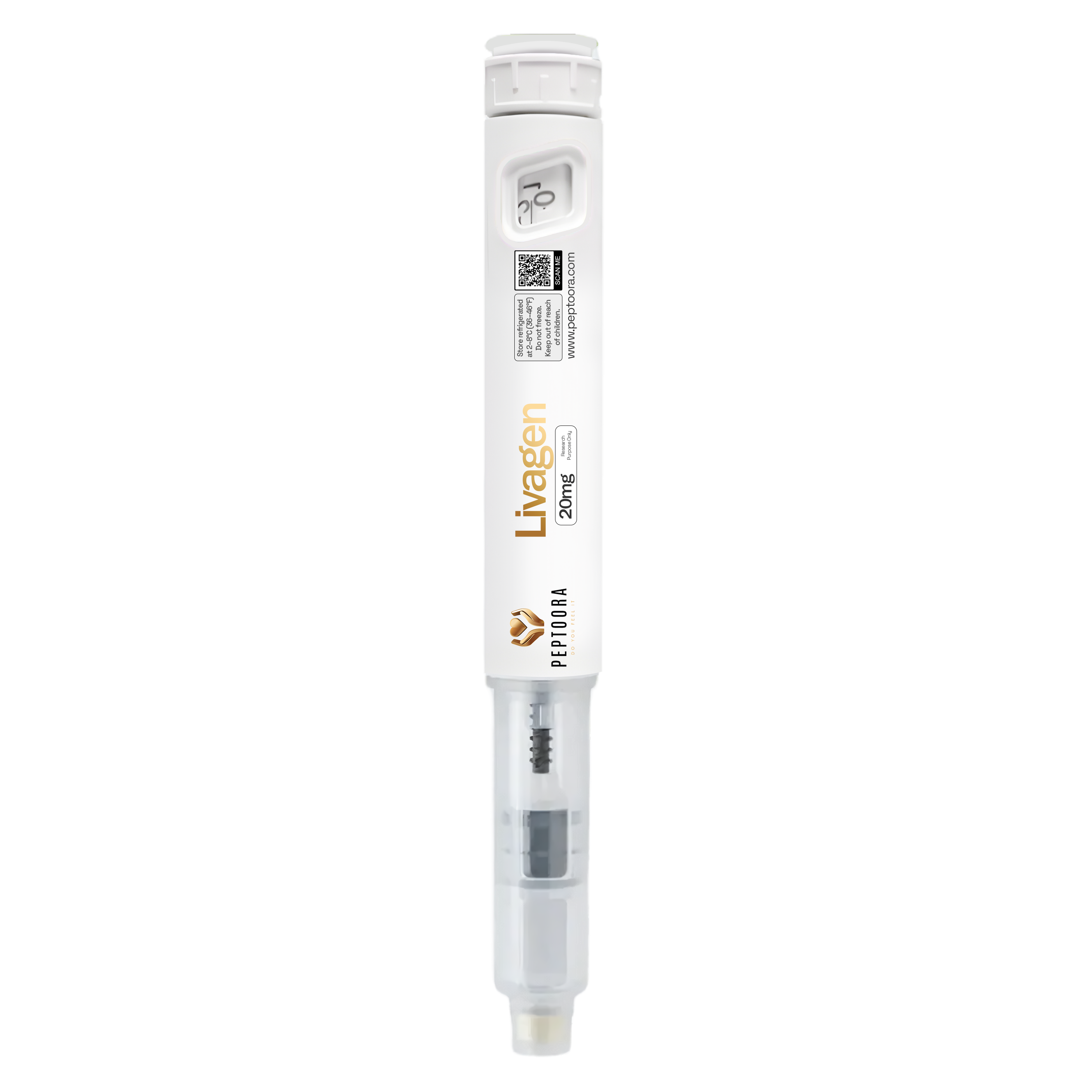
Livagen (Lys-Glu-Asp-Ala) | Pen
Livagen (Lys-Glu-Asp-Ala) is a bioregulator positioned for controlled research settings where hepatic metabolic regulation is being studied in relation to hepatocyte protein-synthesis dynamics, liver enzyme activity and functional resilience, and oxidative-stress / immune-status endpoints.
Supports
- Hepatocyte protein-synthesis rhythm and amplitude readouts in aging models
- Digestive and hepatic enzyme-activity profiling across age-stratified animal studies
- Oxidative-stress and antioxidant-status endpoints in experimental liver pathology designs
- Immune-status normalization markers co-monitored with hepatic function outcomes
- Liver tissue explant growth and tissue-specific activity assays (model dependent)
Description
Livagen (Lys-Glu-Asp-Ala), also referenced as the tetrapeptide KEDA, is an ultrashort peptide bioregulator discussed in the tissue-specific peptide literature with a primary research focus on liver-related models. In experimental settings, KEDA is used as a sequence-defined tool compound to probe how short peptides may influence gene-expression programs, cellular function, and age-associated shifts in organ physiology.
Across preclinical reports, Livagen is commonly framed around hepatocyte function: studies in cultured hepatocytes from animals of different ages describe changes in protein-synthesis dynamics in response to the peptide, while other animal studies discuss shifts in digestive-enzyme activity across organ systems. Separate review literature summarizes hepatoprotective and immunomodulatory properties attributed to KEDA in experimental liver pathology models, emphasizing strong dependence on the chosen model and endpoint set.
Livagen is therefore best positioned as a research reagent for hypothesis-driven study design (e.g., hepatic metabolism, stress-resilience frameworks, and aging-associated liver function), with outcomes interpreted within controlled conditions rather than generalized as clinical effects.
Clinical Status
Publicly accessible evidence for Livagen (KEDA) is primarily preclinical, including animal-model studies and in vitro hepatocyte culture data, alongside review syntheses of experimental liver-pathology models. Human clinical outcomes for Livagen as a standalone intervention are not well established in widely indexed sources, and regulatory approval is not indicated in the provided raw text.
Evidence type:
Human RCT ☐ | Observational ☐ | Animal ✔ | In vitro ✔ | Regulatory approval ☐
Mechanism of Action
Ultrashort peptide bioregulators are commonly discussed as modulators of gene expression and protein synthesis, potentially via interactions with nuclear/chromatin-associated targets in differentiated cells. Within this framework, Livagen (KEDA) is positioned as liver-relevant, with reported effects in hepatocyte culture systems and tissue-level functional assays that align with transcriptional accessibility and downstream protein-synthesis outputs.
In liver-focused experimental designs, KEDA has been discussed in the context of antioxidant and immune-status normalization alongside functional liver markers in pathology models. Mechanistic work is often paired with multi-endpoint profiling—enzyme-activity panels, oxidative-stress markers, immune indices, and functional readouts—to map how prolonged or age-dependent baseline states influence observed effects.
Benefits
-
Liver-focused experimental positioning:
Used as a research tool in study designs centered on hepatic metabolism, detoxification-relevant processes, and functional resilience endpoints. -
Hepatocyte protein-synthesis dynamics:
Reported to influence protein-synthesis rhythmicity/amplitude in hepatocyte cultures from animals of different ages (model dependent). -
Enzyme-activity profiling frameworks:
Included in animal studies measuring shifts in digestive and non-digestive organ enzyme activities across age groups. -
Oxidative-stress endpoint integration:
Discussed within hepatoprotective research contexts that track antioxidant status and oxidative-stress markers in liver pathology models. -
Immune-status co-monitoring:
Review literature describes concordant effects on immune/antioxidant status when KEDA is evaluated in experimental liver pathology settings. -
Tissue-specific activity assays:
Referenced in patent-described explant models and tissue-specific activity frameworks used to define organ selectivity (model dependent).
Research Data
| Study/model | Reported effect |
| Hepatocyte cultures from rats of different ages (in vitro) | Livagen reported to increase the amplitude of protein-synthesis fluctuations in hepatocytes from older animals (age- and assay-dependent). |
| Rats of different ages (in vivo), enzyme-activity panels | Livagen reported to alter activity of digestive enzymes in gastrointestinal tract and non-digestive organs, with age-dependent directionality. |
| Experimental liver pathology models (animals + in vitro; review synthesis) | KEDA discussed as showing hepato- and immunoprotective effects, including restoration of liver function and normalization of immune/antioxidant status (model dependent). |
| Hepatoprotective/immunomodulatory properties of KEDA (review) | Review summarizes KEDA efficacy across experimental liver disease models and discusses age-related amplification of protective effects. |
| Tissue-specific explant growth assays (patent-described) | Lys-Glu-Asp-Ala reported to stimulate liver tissue explant growth as a tissue-specific activity signal (model dependent). |
| Bioregulator framework (mechanistic review) | Short peptides described as regulators of gene expression and protein synthesis across tissues, supporting transcriptomic endpoint selection in liver-focused studies. |
| Ultrashort peptide transport/biostability (review) | KEDA discussed in the context of ultrashort peptide transport and resistance to hydrolysis in physiological media and tissue homogenates (exposure-design relevance). |
| Cross-system endocrine/neuromodulatory endpoints (animal study) | Livagen evaluated alongside other bioregulators in systemic endpoint contexts (e.g., neuroendocrine-related readouts), supporting broader multi-organ study designs. |
Stack Suggestions
In extended experimental designs, Livagen (Lys-Glu-Asp-Ala) is sometimes paired with:
- Glutathione → to co-monitor redox/oxidative-stress endpoints alongside hepatic function readouts
- Thymalin → to explore immune-status co-endpoints in liver pathology and aging-resilience study designs
- Epitalon → to compare short-peptide gene-expression modulation frameworks across different organ-focused bioregulators
Stacks discussed are for experimental design only, not safety/efficacy guidance.
Possible Side Effects
There are no known reports of negative side effects.
Scientific References
- Rhythm of protein synthesis in cultures of hepatocytes from rats of different ages: norm and effect of the peptide Lyvagen — In vitro
- Effect of peptide Livagen on activity of digestive enzymes in gastrointestinal tract and non-digestive organs in rats of different ages — Animal
- The influence of polypeptide liver complex and tetrapeptide KEDA on organism physiological function in norm and age-related pathology — Review (Animal/In vitro)
- Hepatoprotective and immunomodulatory properties of tetrapeptide KEDA (Lys-Glu-Asp-Ala): review of experimental models — Review (Animal/In vitro)
- Method of obtaining peptides with tissue-specific activity (includes Lys-Glu-Asp-Ala liver tissue-specific explant effects) — Patent
- Peptide Regulation of Gene Expression: A Systematic Review — Systematic review
- Transport of Biologically Active Ultrashort Peptides Using POT and LAT Carriers — Review (Mechanistic)
- Peptide medicines: past, present, future — Review
- Effects of Livagen and Epitalon, New Peptide Bioregulators, on the Endogenous Opioid System in the Rat Brain — Animal
- Livagen (KEDA) overview with linked primary literature — Reference summary
Cautions
- For educational and scientific context only; not intended to diagnose, treat, cure, or prevent any disease.
- If you are pregnant, nursing, have a medical condition, or use prescription medication, consult a qualified professional.
- Discontinue use if sensitivity occurs.
Pairs well with
In stock! Ships within 2-6 business days.
Complimentary shipping & returns
Livagen (Lys-Glu-Asp-Ala) | Pen
Why choose us
Experience the difference with our premium service
Schedule easily
Book your appointment in seconds
1-on-1 Guidance Call
Connect from anywhere via video
Expert guidance
Get personalized recommendations
FAQs
Please read our FAQs page to find out more.
Do I need a prescription to place an order?
No prescription is required to place an order. We recommend professional consultation before using any product where applicable.
Are the pens ready to use?
Our systems are designed for convenience and consistency. Product-specific handling and storage guidance is provided with each order.
Are these products intended to diagnose, treat, cure, or prevent disease?
No. Products are not intended to diagnose, treat, cure, or prevent any disease.
When will my order be shipped?
Orders are typically dispatched within 2–4 business days, subject to product availability and verification. Once shipped, delivery time depends on your destination and carrier.
How should I store products after delivery?
Store products according to the label and included guidance. Some products may require refrigeration after opening. Improper storage can impact product integrity.