


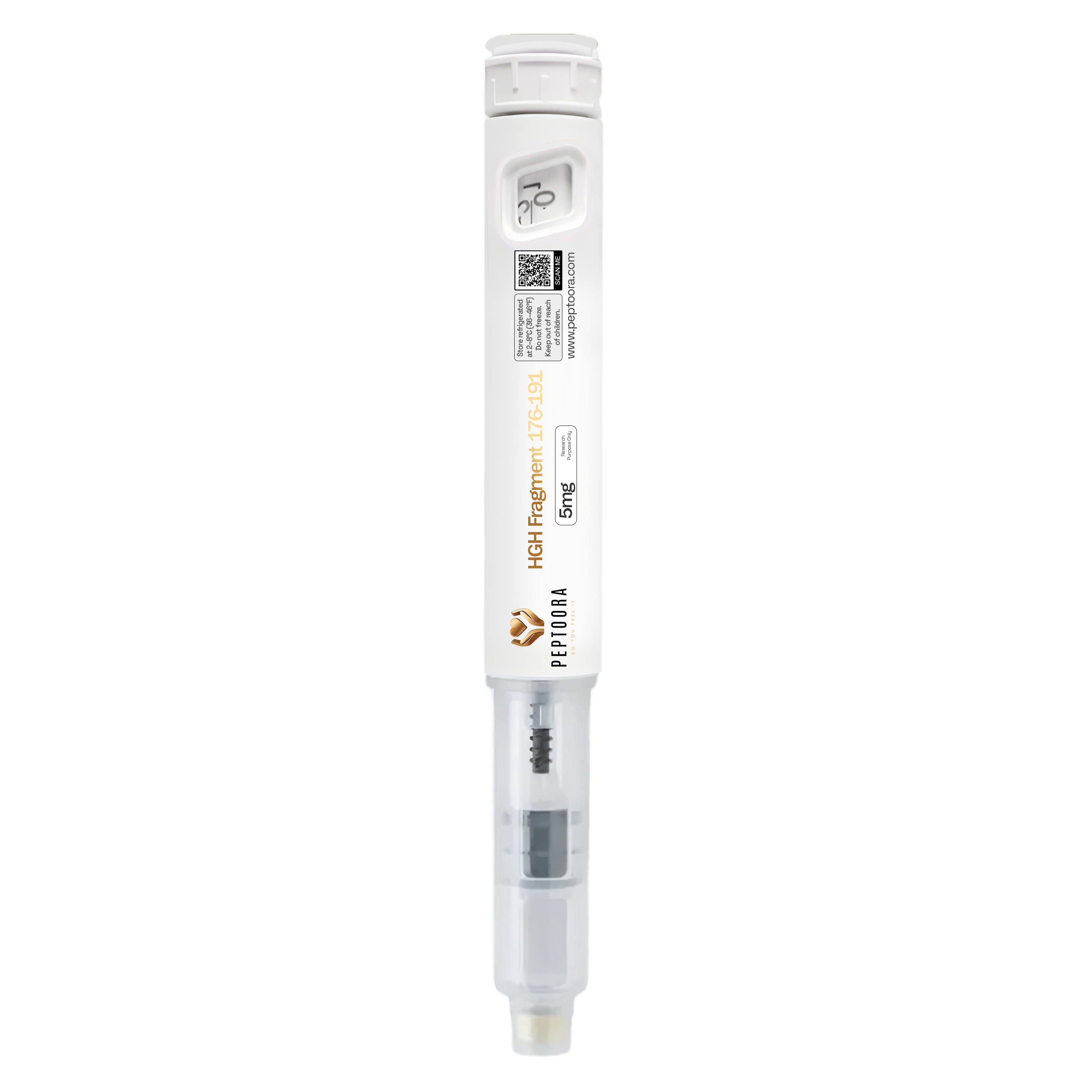
HGH Fragment 176-191 | Pen
HGH Frag (176-191) is a peptide positioned for controlled research settings where adipose lipid-handling physiology is being studied in relation to lipolysis readouts, lipogenesis suppression markers, and body-composition endpoints.
Supports
- Adipocyte lipolysis signaling endpoints (cAMP/PKA-linked, model-dependent)
- Lipogenesis suppression markers (ACC/FAS-associated readouts in models)
- Fat mass and adiposity distribution endpoints (protocol-dependent)
- Triglyceride and lipid-panel changes tracked in metabolic studies
- Fatty-acid oxidation and mitochondrial utilization markers (β-oxidation readouts)
Description
HGH Frag (176-191) refers to a short C-terminal fragment derived from human growth hormone sequence research, positioned primarily for experiments focused on adipose biology rather than the broader growth-related signaling typically associated with full-length somatropin. In research discussions, this fragment and closely related analogs are explored for model-dependent effects on lipid mobilization and fat-storage pathways.
Across experimental settings, investigators typically track endpoints such as adipocyte signaling readouts (e.g., cAMP-associated lipolysis markers), changes in triglyceride handling, and body-composition outcomes in diet-induced obesity or metabolic challenge models. In vitro work often focuses on adipocyte enzyme activity and fatty-acid mobilization, while in vivo studies evaluate fat mass change, lipid panels, and related metabolic markers over time.
This product is positioned strictly for research use, where outcomes should be interpreted within controlled protocols and predefined endpoints.
Clinical Status
Available evidence is primarily preclinical and in vitro, with limited human observational reporting discussed in some secondary sources. This fragment is not described as an approved therapy in the provided raw text and remains positioned as investigational for experimental use.
Evidence type:
Human RCT ☐ | Observational ✔ | Animal ✔ | In vitro ✔ | Regulatory approval ☐
Mechanism of Action
In experimental models, HGH Frag (176-191) is studied for adipocyte-targeted signaling effects associated with lipid mobilization. Mechanistic discussions commonly emphasize cAMP-associated pathways and downstream activation of lipolytic enzymes such as hormone-sensitive lipase (HSL) and adipose triglyceride lipase (ATGL), with readouts including glycerol/free fatty acid release and lipase activation markers.
Parallel investigations may track reduced lipogenesis-associated signals (e.g., suppression of lipogenic enzyme expression/activity) and shifts toward fatty-acid oxidation markers in cellular and animal models. Importantly, research positioning often distinguishes this fragment’s adipose-focused endpoints from the broader GH receptor/IGF-1 axis biology attributed to full-length growth hormone, while acknowledging that observed effects remain model- and protocol-dependent.
Benefits
-
Targeted Fat Metabolism Without Growth Effects:
HGH Frag (176-191) is a synthetic peptide fragment of human growth hormone designed to selectively activate fat-burning pathways without stimulating overall growth or insulin resistance. It represents the lipolytic domain of the HGH molecule and is studied for its ability to promote efficient fat metabolism while avoiding the systemic hormonal effects of full-length HGH. -
Enhanced Lipolysis and Reduction of Adipose Tissue:
Research demonstrates that HGH Frag (176-191) significantly increases lipolysis and fatty acid oxidation in adipose cells. By stimulating hormone-sensitive lipase and inhibiting lipogenesis, it reduces stored fat, particularly in stubborn regions such as the abdomen. These effects have made it a central focus in metabolic and obesity-related peptide studies. -
Improved Fat Utilization and Energy Efficiency:
In preclinical and clinical research, HGH Frag enhances fat mobilization for energy production while maintaining glucose homeostasis. This shift in substrate preference toward lipid oxidation supports overall metabolic efficiency and energy balance, distinguishing it from traditional weight loss interventions that often compromise muscle tissue. -
Preservation of Lean Muscle Mass:
Unlike full-length HGH, this peptide fragment does not promote insulin resistance or excessive IGF-1 stimulation, allowing fat reduction without muscle catabolism. Research indicates that HGH Frag (176-191) helps preserve lean body mass even during caloric restriction, supporting favorable body composition outcomes in experimental protocols. -
Improvement of Lipid and Glucose Regulation:
HGH Frag has been observed to improve lipid metabolism and insulin sensitivity by promoting fatty acid oxidation and reducing circulating triglycerides. It does not interfere with carbohydrate metabolism, which allows stable glucose levels throughout the research period, highlighting its safety and selectivity compared to full-length somatropin. -
Localized Fat Reduction Potential:
Preclinical data suggest that HGH Frag (176-191) may exert region-specific fat loss effects due to localized receptor activation. This has led to ongoing research on targeted administration protocols to influence stubborn fat areas, providing insights into site-specific lipolytic modulation mechanisms. -
Improved Mitochondrial Activity and Energy Expenditure:
Studies indicate that HGH Frag increases mitochondrial fatty acid oxidation, supporting enhanced ATP production and thermogenic activity. This improvement in mitochondrial efficiency underlies its observed effects on sustained energy expenditure, making it a promising candidate for metabolic rate optimization research. -
No Impact on Growth or Proliferative Pathways:
Unlike native HGH, this peptide fragment does not activate pro-growth or mitogenic signaling pathways. It does not elevate IGF-1 levels or stimulate cell proliferation, resulting in a safer metabolic profile for long-term experimental use focused purely on fat metabolism and energy balance. -
Support for Weight Management and Body Recomposition:
Due to its ability to target fat reduction while preserving lean tissue, HGH Frag (176-191) is commonly included in research focusing on body recomposition, metabolic flexibility, and adipose regulation. Its selective action provides an effective model for studying sustained weight management mechanisms without endocrine disruption. -
Synergistic Potential with Metabolic and Recovery Peptides:
HGH Frag (176-191) is frequently studied in combination with AOD-9604, CJC-1295, or Ipamorelin to enhance lipolytic, regenerative, and anabolic outcomes. These experimental stacks explore synergistic pathways that optimize fat oxidation, hormonal balance, and recovery potential in performance and longevity research. -
Favorable Safety Profile and Non-Mitogenic Nature:
Extensive preclinical testing shows that HGH Frag (176-191) maintains a favorable safety profile with no proliferative effects on bone or organ tissue. Its specificity for fat metabolism makes it a preferred choice in experimental studies aiming for targeted lipolysis without systemic growth factor stimulation.
Research Data
| Study/model | Reported effect |
| Animal models (obese mice) |
↓ total body fat by 50% within 4 weeks; ↑ lipolysis without changes in IGF-1
|
| In vitro adipocyte studies |
↑ cAMP and activation of hormone-sensitive lipase; ↓ triglyceride synthesis
|
| Human observational studies |
↓ abdominal fat thickness and improved skinfold measurements
|
| High-fat diet rodent models |
↓ visceral adipose tissue and plasma triglycerides
|
| Comparative studies (vs HGH) |
Equivalent fat-burning efficacy with reduced side effects
|
| Cell culture mitochondrial assays |
↑ β-oxidation enzyme expression and oxygen consumption rate
|
| Preclinical tolerance tests |
No influence on glucose or insulin levels; no water retention observed
|
Stack Suggestions
In extended experimental designs, HGH Frag (176-191) is sometimes paired with:
- Semaglutide (GLP-1S) → appetite/energy-intake endpoints alongside adiposity readouts
- MOTS-c → metabolic flexibility and mitochondrial utilization markers in multi-compound designs
- NAD+ → redox/energy-state endpoints tracked alongside fatty-acid oxidation measures
- Often combined with IGF-1 LR3 for muscle preservation during fat loss
- Stacked with BPC-157 for tissue recovery after rapid recomposition
Stacks discussed are for experimental design only, not safety/efficacy guidance.
Possible Side Effects
HGH Frag (176-191), as a research peptide focused on lipolysis, may induce mild side effects in experimental models, mainly localized or transient. These are dose-related and more notable at higher levels. Close monitoring is advised for subcutaneous delivery.
Injection Site Reactions: Redness, swelling, or itching at the site, resolving within hours. Rotating areas reduces this.
Headache: Mild, possibly from vascular changes or rapid fat mobilization.
Nausea: Occasional queasiness, linked to metabolic shifts early on.
Fatigue: Transient lethargy, due to energy redirection.
Increased Heart Rate: Slight tachycardia in sensitive models, attributed to adrenergic activation.
Most side effects are minor and manageable via dose adjustment. Limited data suggest no long-term risks like insulin disruption, though vigilance for hypersensitivity is recommended.
Scientific References
- The effects of human GH and its lipolytic fragment (AOD9604) on lipid metabolism following chronic treatment in obese mice and beta(3)-AR knock-out mice — Animal
- Metabolic studies of a synthetic lipolytic domain (AOD9604) of human growth hormone — Animal
- Detection and in vitro metabolism of AOD9604 — In vitro
- Effect of intra-articular injection of AOD9604 with or without hyaluronic acid in a rabbit osteoarthritis model — Animal
- Obesity drugs in clinical development — Review
- Identification and characterization of peptide drugs in unknown pharmaceutical preparations seized by the Belgian authorities: case report on AOD9604 — Observational
- Human growth hormone fragment 176-191 peptide enhances the toxicity of doxorubicin-loaded chitosan nanoparticles against MCF-7 breast cancer cells — In vitro
- Human growth hormone fragment 176-191 peptide enhances the toxicity of doxorubicin-loaded chitosan nanoparticles against MCF-7 breast cancer cells — In vitro
- AOD9604 randomized trial literature (PubMed search) — Human/Review
- Growth hormone fragment 176-191 and lipolysis endpoints (PubMed search) — Preclinical/Review
- Human growth hormone fragment 176-191 peptide enhances the toxicity of doxorubicin-loaded chitosan nanoparticles against MCF-7 breast cancer cells In vitro
- Detection and in vitro metabolism of AOD9604 In vitro
- The effects of human GH and its lipolytic fragment (AOD9604) on lipid metabolism following chronic treatment in obese mice and beta(3)-AR knock-out mice Animal
- Metabolic studies of a synthetic lipolytic domain (AOD9604) of human growth hormone Animal
- Identification and characterization of peptide drugs in unknown pharmaceutical preparations seized by the Belgian authorities: case report on AOD9604 Observational
- Effect of intra-articular injection of AOD9604 with or without hyaluronic acid in a rabbit osteoarthritis model Animal
- Obesity drugs in clinical development Review
- Effects of oral administration of synthetic fragment of human growth hormone on lipid metabolism Animal
- Human growth hormone fragment 176-191 peptide enhances the toxicity of doxorubicin-loaded chitosan nanoparticles against MCF-7 breast cancer cells In vitro
- Fragment 176-191 peptide and studies in weight Review
Cautions
- For educational and scientific context only; not intended to diagnose, treat, cure, or prevent any disease.
- If you are pregnant, nursing, have a medical condition, or use prescription medication, consult a qualified professional.
- Discontinue use if sensitivity occurs.
Pairs well with
In stock! Ships within 2-6 business days.
Complimentary shipping & returns
HGH Fragment 176-191 | Pen
FAQs
Please read our FAQs page to find out more.
Do I need a prescription to place an order?
No prescription is required to place an order. We recommend professional consultation before using any product where applicable.
Are the pens ready to use?
Our systems are designed for convenience and consistency. Product-specific handling and storage guidance is provided with each order.
Are these products intended to diagnose, treat, cure, or prevent disease?
No. Products are not intended to diagnose, treat, cure, or prevent any disease.
When will my order be shipped?
Orders are typically dispatched within 2–4 business days, subject to product availability and verification. Once shipped, delivery time depends on your destination and carrier.
How should I store products after delivery?
Store products according to the label and included guidance. Some products may require refrigeration after opening. Improper storage can impact product integrity.