


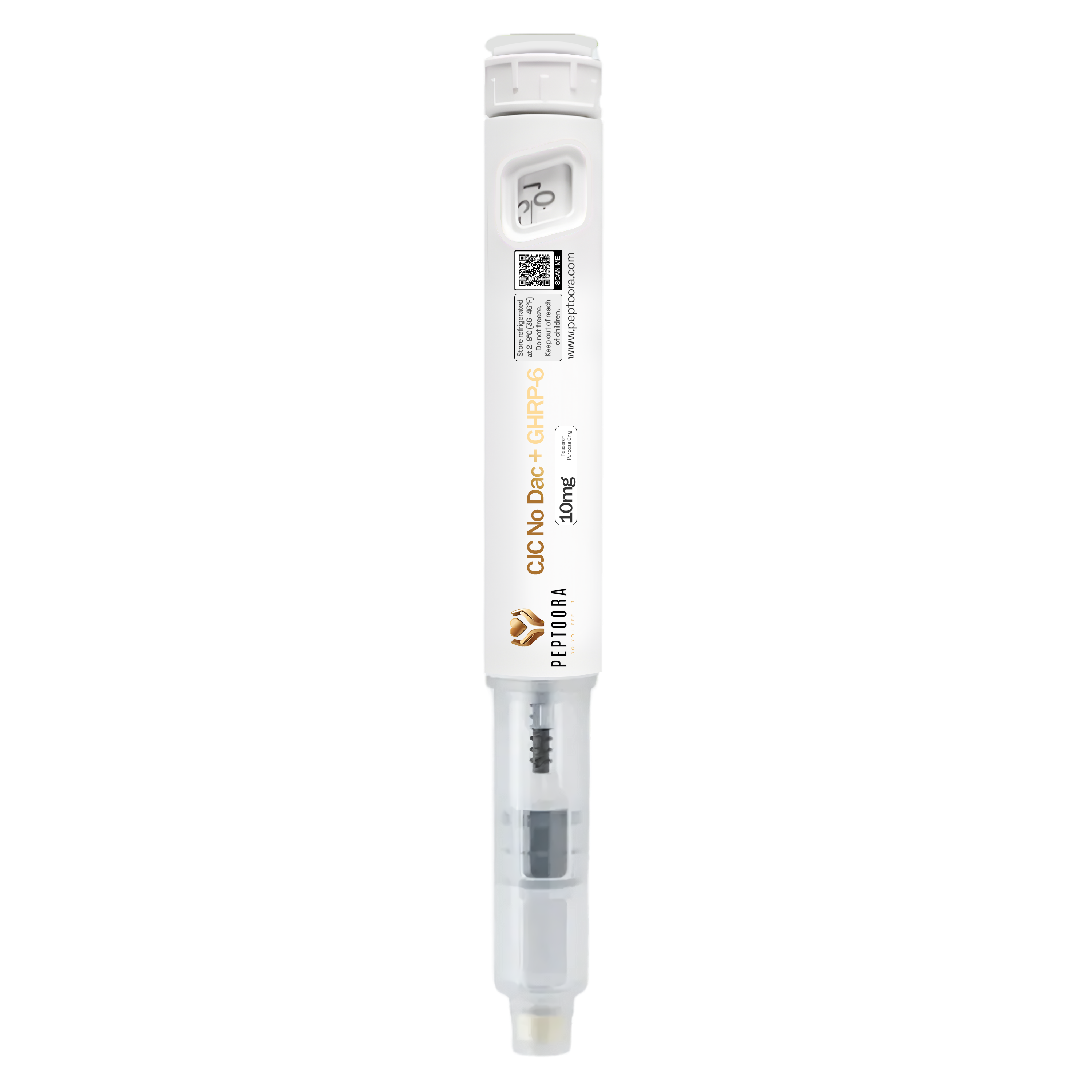
CJC-1295 (No DAC) + GHRP-6 | Pen
CJC-1295 (No DAC) + GHRP-6 is a blend positioned for controlled research settings where pulsatile growth hormone signaling is being studied in relation to GH/IGF-1 biomarker dynamics, body composition endpoints, and recovery- and sleep-linked physiology markers.
Supports
- Pituitary GH pulse amplitude and frequency endpoints (model-dependent)
- IGF-1 biomarker tracking as a downstream axis readout (endpoint-dependent)
- Substrate utilization and body composition marker panels in metabolic models
- Sleep-architecture and recovery-associated signaling proxies (context-dependent)
- Appetite and ghrelin-pathway behavioral readouts in controlled models (GHSR-linked)
Description
CJC-1295 (No DAC) + GHRP-6 combines two peptide classes commonly used to study growth hormone (GH) physiology from complementary angles. CJC-1295 (No DAC), also referred to as a stabilized GHRH (growth hormone-releasing hormone) analog, is positioned to explore pituitary receptor signaling that promotes GH release. GHRP-6 is a growth hormone secretagogue peptide studied for ghrelin receptor (GHSR) agonism and GH pulse facilitation.
In experimental designs, the blend is often framed as a “dual-pathway” approach: a GHRH-analog signal that supports pituitary GH release biology, paired with a GHSR-agonist signal that can modulate pulse characteristics and associated behavioral/metabolic markers. Research outcomes are typically evaluated through time-resolved GH and IGF-1 biomarkers, metabolic endpoints (lipid oxidation and glucose handling proxies), and recovery-linked readouts such as sleep or training-stress adaptation markers, depending on the model.
Because GH-axis outputs can vary with baseline endocrine state, sampling strategy, and assay design, interpretation is usually endpoint-driven and paired with structured controls (baseline hormone panels, serial sampling, and standardized challenge conditions where applicable).
Clinical Status
This blend is positioned for research use. Human evidence exists for GH secretagogues and GHRH-analog pharmacology in selected contexts, while many mechanistic claims are most robustly supported by controlled endocrine physiology literature and preclinical models. The combination itself is best interpreted through biomarker-driven endpoints rather than generalized outcome claims.
Evidence type:
Human RCT ☐ | Observational ☐ | Animal ✔ | In vitro ✔ | Regulatory approval ☐
Mechanism of Action
CJC-1295 (No DAC) is used as a GHRH-analog input to study signaling at the pituitary GHRH receptor, which can promote GH secretion under controlled conditions. GHRP-6 is studied as a ghrelin receptor (GHSR) agonist, a pathway known to influence GH release patterns and appetite-linked signaling in many experimental paradigms.
When combined, experimental designs may examine whether concurrent GHRH-receptor signaling and GHSR signaling produces additive or synergistic changes in GH pulse profiles and downstream IGF-1 readouts. Mechanistic assessment typically includes serial hormone sampling (GH pulses), downstream biomarker monitoring (IGF-1), and secondary endpoints such as metabolic readouts (substrate utilization proxies) and sleep/recovery markers where relevant.
Benefits
-
Dual-pathway GH-axis modeling:
Supports studies evaluating GH secretion biology via combined GHRH-receptor and GHSR-linked signaling inputs. -
Time-resolved endocrine biomarker tracking:
Enables protocols focused on serial GH sampling and downstream IGF-1 biomarker dynamics (model-dependent). -
Metabolic endpoint integration:
Relevant to designs examining substrate utilization, lipid handling, and glucose regulation proxies alongside GH-axis markers. -
Recovery and sleep-related physiology markers:
Supports exploratory work where sleep architecture or recovery-associated signals are studied in relation to GH pulsatility. -
Appetite and neuroendocrine signaling readouts:
GHSR agonism is often paired with behavioral and appetite-related endpoints in controlled models (context-dependent). -
Experimental controllability without direct GH replacement:
Positions GH-axis modulation as an upstream signaling study approach, emphasizing biomarker-defined outputs and controls.
Research Data
| Study/model | Reported effect |
| Pituitary GHRH receptor signaling assays (in vitro) | GHRH-analog stimulation used to quantify GH-release pathway activation and receptor-linked signaling endpoints |
| Ghrelin receptor agonism models (in vitro/animal) | GHSR activation measured via endocrine outputs and appetite-linked signaling readouts |
| Serial GH sampling protocols (endocrine physiology models) | GH pulse amplitude/frequency quantified as primary endpoints; sampling strategy strongly shapes interpretation |
| IGF-1 downstream biomarker monitoring | IGF-1 used as a downstream axis marker to contextualize GH signaling over time |
| Energy metabolism challenge paradigms (animal) | Substrate utilization proxies and lipid/glucose markers assessed alongside endocrine changes |
| Sleep-linked GH physiology frameworks | Sleep architecture and nocturnal GH dynamics studied as coupled physiological endpoints in controlled settings |
| Appetite and feeding behavior assays (animal) | GHSR-linked behavioral endpoints tracked in parallel with endocrine readouts |
| Combination secretagogue designs (preclinical) | GHRH-analog + GHSR agonist pairings used to test additive effects on GH pulse profiles and downstream markers |
Stack Suggestions
In extended experimental designs, CJC-1295 (No DAC) + GHRP-6 is sometimes paired with:
- IGF-1 LR3 → to compare upstream GH-axis modulation with direct IGF-axis endpoint frameworks
- SS-31 (Elamipretide) → to add mitochondrial resilience readouts alongside recovery-linked biomarker panels
- AICAR → to integrate AMPK-linked metabolic switching endpoints with GH/IGF biomarker tracking
Stacks discussed are for experimental design only, not safety/efficacy guidance.
Possible Side Effects
No product-specific adverse-effect text was provided. In research contexts involving GH secretagogues and ghrelin-pathway agonism, model-dependent observations can include appetite-related effects, transient changes in water balance markers, shifts in glucose-related biomarkers, and injection-site reactions (redness, sensitivity, mild swelling). Endocrine outputs and tolerability signals can vary by baseline physiology and protocol duration, so controlled monitoring of biomarkers and discontinuation upon sensitivity signals are standard experimental precautions.
Scientific References
- GHRH receptor signaling and pituitary GH release mechanisms (PubMed search) — Review
- Mod GRF (1-29) / CJC-1295 (No DAC) pharmacology and endocrine endpoints (PubMed search) — In vitro/Animal
- GHRP-6 as a growth hormone secretagogue: endocrine physiology endpoints (PubMed search) — In vitro/Animal
- Ghrelin receptor (GHSR) agonism and GH release biology (PubMed search) — Review
- Growth hormone pulsatility and serial sampling methodology (PubMed search) — Review
- IGF-1 as a downstream biomarker of GH-axis activity (PubMed search) — Review
- Sleep architecture and nocturnal growth hormone pulse physiology (PubMed search) — Review
- Ghrelin receptor agonism and appetite/feeding behavior endpoints (PubMed search) — Animal
- Growth hormone secretagogues: mechanisms, biomarkers, and model considerations (PubMed search) — Review
- GHRH analog + ghrelin agonist combination designs and GH-axis endpoint outcomes (PubMed search) — Animal/In vitro
Cautions
- For educational and scientific context only; not intended to diagnose, treat, cure, or prevent any disease.
- If you are pregnant, nursing, have a medical condition, or use prescription medication, consult a qualified professional.
- Discontinue use if sensitivity occurs.
Pairs well with
In stock! Ships within 2-6 business days.
Complimentary shipping & returns
CJC-1295 (No DAC) + GHRP-6 | Pen
FAQs
Please read our FAQs page to find out more.
Do I need a prescription to place an order?
No prescription is required to place an order. We recommend professional consultation before using any product where applicable.
Are the pens ready to use?
Our systems are designed for convenience and consistency. Product-specific handling and storage guidance is provided with each order.
Are these products intended to diagnose, treat, cure, or prevent disease?
No. Products are not intended to diagnose, treat, cure, or prevent any disease.
When will my order be shipped?
Orders are typically dispatched within 2–4 business days, subject to product availability and verification. Once shipped, delivery time depends on your destination and carrier.
How should I store products after delivery?
Store products according to the label and included guidance. Some products may require refrigeration after opening. Improper storage can impact product integrity.