


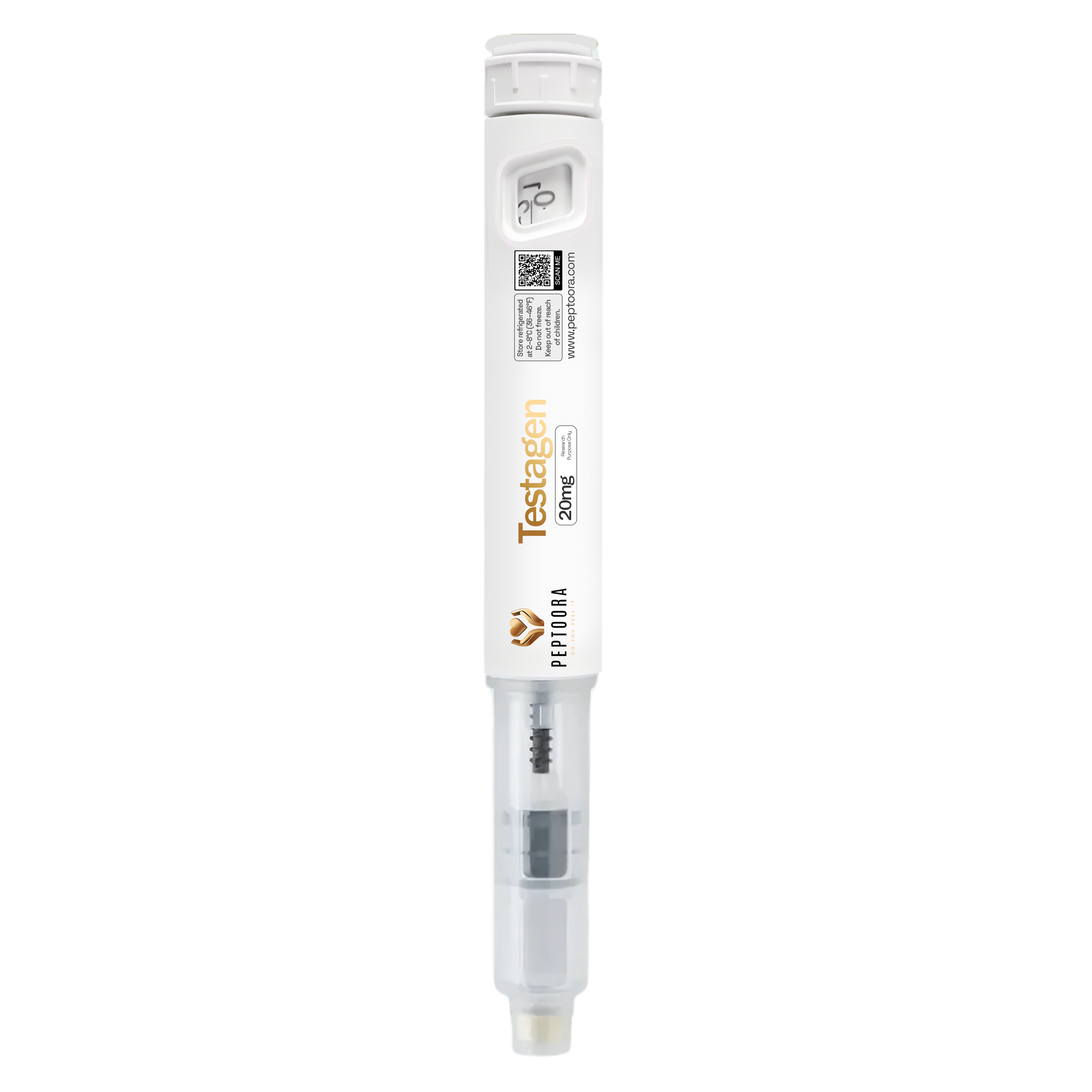
Testagen (Lys-Glu-Asp-Gly) | Pen
Testagen (Lys-Glu-Asp-Gly) is a bioregulator positioned for controlled research settings where endocrine-axis regulation is being studied in relation to hormone signaling profiles, tissue-specific gene-expression programs, and system-level metabolic homeostasis endpoints.
Supports
- Endocrine-responsive gene-expression signatures in model systems
- Pituitary-dependent physiology readouts in endocrine-perturbation paradigms
- Immune–endocrine crosstalk endpoints in differentiation/proliferation assays
- Cell stress and inflammatory transcription outputs in controlled in vitro models
- Transport/uptake considerations for ultrashort peptides in exposure design
Description
Testagen (Lys-Glu-Asp-Gly), also referenced as the tetrapeptide KEDG, is an ultrashort peptide bioregulator discussed within peptide-based regulatory frameworks that investigate how short sequences can influence cellular programs under controlled experimental conditions. In this context, ultrashort peptides are typically treated as sequence-defined research tools for probing transcriptional regulation and downstream phenotypes rather than as clinically established interventions.
Because endocrine function is fundamentally networked (hypothalamus–pituitary axes, peripheral gland responses, and tissue-level feedback loops), research designs using Testagen often emphasize measurable endpoints such as endocrine-responsive gene expression, axis-linked physiological markers, and correlated metabolic readouts. Reported effects are model-dependent and can vary substantially based on baseline state, organism age, tissue context, and assay platform.
Testagen is therefore best positioned for hypothesis-driven studies that explicitly define the endocrine context (e.g., pituitary-dependent paradigms, stress-axis markers, or endocrine–immune crosstalk) and use controlled comparators to interpret sequence-specific signals.
Clinical Status
Open, widely indexed evidence specifically characterizing Testagen/KEDG is largely mechanistic and preclinical. Peer-reviewed sources place KEDG within ultrashort-peptide bioregulator systems and describe related effects across model organisms and in vitro assays, including endocrine-relevant perturbation paradigms. Robust, regulator-approved clinical outcomes establishing efficacy for endocrine endpoints are not established in the broadly accessible literature, and regulatory approval is not indicated in the provided raw text.
Evidence type:
Human RCT ☐ | Observational ☐ | Animal ✔ | In vitro ✔ | Regulatory approval ☐
Mechanism of Action
Ultrashort peptide bioregulators are commonly described as modulators of gene expression and protein synthesis, with proposed mechanisms that include sequence-dependent interactions with cellular and nuclear targets and downstream shifts in transcriptional accessibility. Within this framework, Testagen/KEDG is positioned as an endocrine-oriented regulatory peptide in the broader bioregulator literature, supporting study designs that prioritize transcript-level outputs and downstream functional markers.
Experimental interpretation typically benefits from integrating multiple readout layers: (1) endocrine-responsive transcription signatures, (2) system-level physiology in pituitary-dependent paradigms, and (3) secondary network measures such as inflammatory transcription outputs and metabolic markers. Uptake and distribution assumptions may be informed by di-/oligopeptide transporter biology and ultrashort peptide transport frameworks described for POT/LAT carrier systems.
Benefits
-
Endocrine-axis research positioning:
Supports controlled studies focused on endocrine network regulation using defined molecular and physiological endpoints. -
Gene-expression endpoint compatibility:
Fits experimental designs that quantify transcriptional responses and protein-synthesis outputs associated with endocrine signaling. -
Pituitary-dependent paradigm utility:
Can be integrated into endocrine perturbation models where pituitary influence is a primary variable (model dependent). -
Immune–endocrine crosstalk mapping:
Useful in study designs that co-monitor differentiation/proliferation markers and endocrine-responsive signals. -
Inflammation/stress readout integration:
Enables inclusion of inflammatory transcription outputs and stress-linked markers as secondary endpoints in endocrine frameworks. -
Transport-informed exposure design:
Allows study protocols to reference ultrashort peptide transport concepts when planning exposure timing and tissue relevance.
Research Data
| Study/model | Reported effect |
| Chicks of different ages; neonatal hypophysectomy model (thymus morphology) | Peptides including Lys-Glu-Asp-Gly were evaluated in an endocrine-perturbation paradigm; age-dependent morphology-related outcomes reported (model dependent). |
| Mechanistic synthesis: peptide regulation of gene expression (multiple models) | Ultrashort peptides described as regulators of transcriptional programs and protein synthesis, supporting transcriptomic endpoint selection for endocrine frameworks. |
| Systematic review of peptide regulation of gene expression | Reviews evidence that short peptides modulate gene expression across tissues and systems; includes KEDG among peptides discussed within regulatory frameworks. |
| Transport framework review (POT/LAT carrier systems) | Describes plausible uptake/transport pathways for ultrashort peptides, informing exposure design assumptions in endocrine–immune study contexts. |
| In vitro functional profiling context (cell models; inflammation/proliferation endpoints) | Khavinson-peptide literature includes in vitro models assessing proliferative and inflammatory processes as proxy endpoints for system regulation (model dependent). |
| Chemical/sequence characterization (KEDG as defined tetrapeptide) | Peer-reviewed characterization of KEDG as a defined tetrapeptide supports identity/sequence clarity for experimental design and materials documentation. |
| Bioregulation-system framework (theory and evidence synthesis) | Bioregulator models describe organ/system specificity and participation in differentiation/proliferation regulation, supporting structured endpoint planning. |
| Peptide medicines development landscape (context) | Reviews broader peptide therapeutic research principles (stability, targets, development considerations) relevant to positioning ultrashort peptides as research tools. |
Stack Suggestions
In extended experimental designs, Testagen (Lys-Glu-Asp-Gly) is sometimes paired with:
- Vilon (Lys-Glu) → to compare ultrashort-peptide regulatory signatures across different sequence classes
- Thymogen (Glu-Trp) → to co-monitor immune–endocrine crosstalk endpoints in differentiation/proliferation assay panels
- Epitalon (Ala-Glu-Asp-Gly) → to contrast transcriptional endpoint shifts across tetrapeptide bioregulators in aging/resilience designs
Stacks discussed are for experimental design only, not safety/efficacy guidance.
Possible Side Effects
There are no known reports of negative side effects.
Scientific References
- Effect of Peptides Lys-Glu-Asp-Gly and Ala-Glu-… on the Morphology of the Thymus in Chicks of Different Age after Neonatal Hypophysectomy — Animal
- Transport of Biologically Active Ultrashort Peptides Using POT and LAT Carriers — Review (Mechanistic)
- Peptide Regulation of Gene Expression: A Systematic Review — Systematic review
- Peptide Regulation of Gene Expression: A Systematic Review — Systematic review
- The Inhibitory Effect and Adsorption Properties of Testagen Peptide on Copper Surfaces in Saline Environments: An Experimental and Computational Study — In vitro
- The Inhibitory Effect and Adsorption Properties of Testagen Peptide on Copper Surfaces in Saline Environments: An Experimental and Computational Study — In vitro
- Peptides Regulating Proliferative Activity and Inflammatory Processes: Evidence and Mechanisms in Cell Models — In vitro
- Peptide medicines: past, present, future — Review
- Peptide Regulation of Gene Expression: A Systematic Review (PDF) — Systematic review
- PubChem: Lys-Glu-Asp-Gly (KEDG) compound records and related entries — Reference (Chemical)
Cautions
- For educational and scientific context only; not intended to diagnose, treat, cure, or prevent any disease.
- If you are pregnant, nursing, have a medical condition, or use prescription medication, consult a qualified professional.
- Discontinue use if sensitivity occurs.
Pairs well with
In stock! Ships within 2-6 business days.
Complimentary shipping & returns
Testagen (Lys-Glu-Asp-Gly) | Pen
FAQs
Please read our FAQs page to find out more.
Do I need a prescription to place an order?
No prescription is required to place an order. We recommend professional consultation before using any product where applicable.
Are the pens ready to use?
Our systems are designed for convenience and consistency. Product-specific handling and storage guidance is provided with each order.
Are these products intended to diagnose, treat, cure, or prevent disease?
No. Products are not intended to diagnose, treat, cure, or prevent any disease.
When will my order be shipped?
Orders are typically dispatched within 2–4 business days, subject to product availability and verification. Once shipped, delivery time depends on your destination and carrier.
How should I store products after delivery?
Store products according to the label and included guidance. Some products may require refrigeration after opening. Improper storage can impact product integrity.