


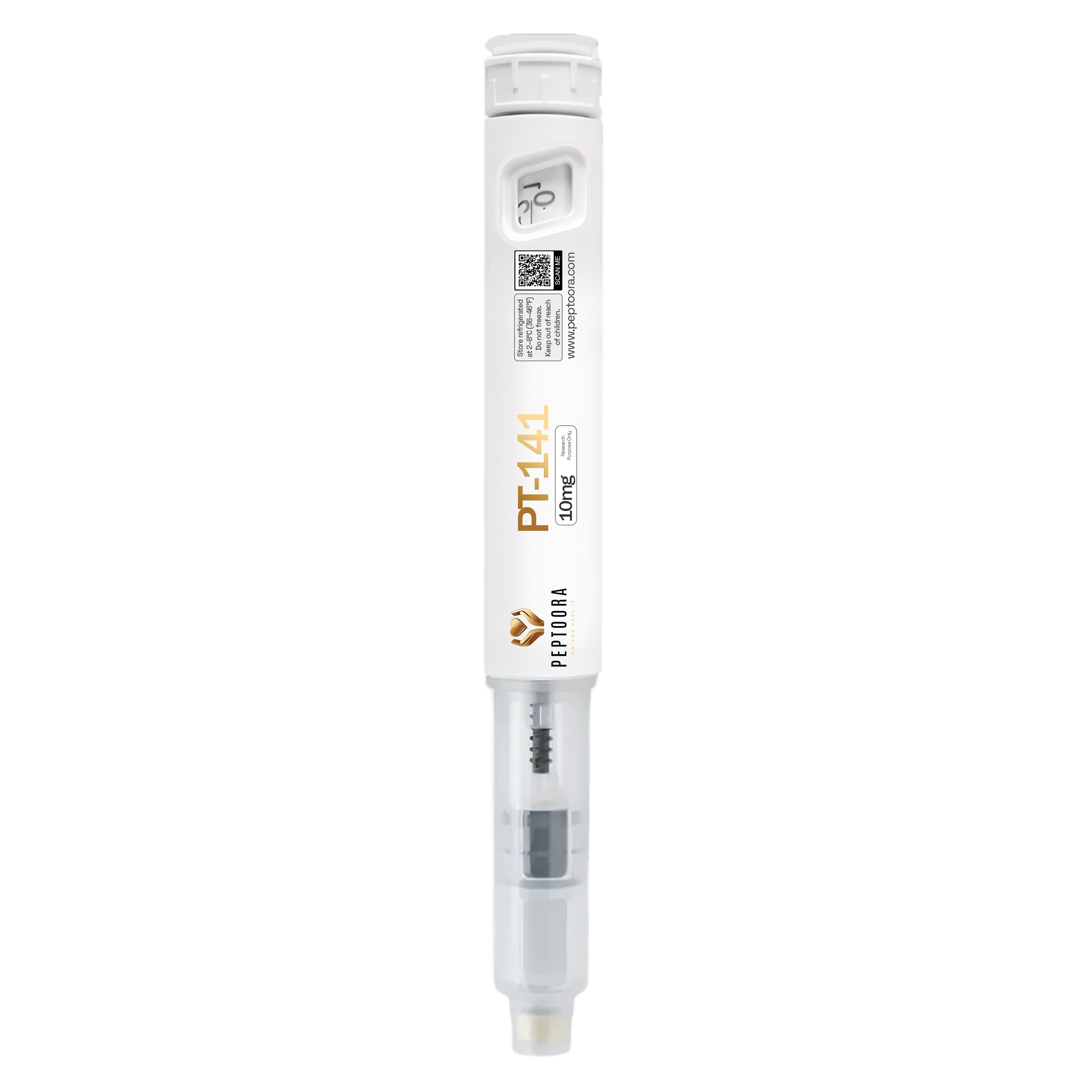
PT-141 (Bremelanotide) | Pen
PT-141 (Bremelanotide) is a peptide positioned for controlled research settings where central melanocortin-driven arousal signaling is being studied in relation to sexual desire and distress endpoints, hypothalamic circuit activation, and reward-linked neurotransmitter modulation.
Supports
- Central arousal signaling and sexual desire scoring endpoints (model-dependent)
- Melanocortin receptor (MC3R/MC4R) pathway engagement in hypothalamic circuits
- Reward-circuit neurotransmitter modulation linked to motivational behavior readouts
- Sexual distress and satisfaction-related outcome measures in controlled cohorts
- Neurobehavioral arousal integration independent of peripheral vasodilation mechanisms
Description
PT-141 (bremelanotide) is a synthetic melanocortin receptor agonist derived from α-MSH analog research, developed to probe central mechanisms of sexual motivation and arousal. In contrast to agents that primarily act on peripheral vascular pathways, PT-141 is studied as a CNS-active compound engaging melanocortin signaling in hypothalamic and limbic networks associated with desire and motivational drive.
In human clinical research, bremelanotide has been evaluated using validated desire and distress instruments, with outcomes typically interpreted as changes in central arousal signaling rather than direct smooth muscle relaxation. Preclinical literature supports a mechanistic focus on MC4R/MC3R-linked circuitry, including hypothalamic neuronal activation and downstream neurotransmitter effects relevant to arousal-state transitions.
PT-141 is presented on Peptoora for research positioning only, where experimental designs can examine melanocortin receptor pharmacology, circuit-level activation patterns, and behavioral endpoints under controlled conditions.
Clinical Status
PT-141 (bremelanotide) has been evaluated in multiple controlled human trials for sexual desire endpoints and has been approved in certain jurisdictions for a specific indication in female sexual desire disorders. Mechanistic understanding is supported by animal and translational neuroscience studies that characterize melanocortin receptor signaling and hypothalamic circuit engagement.
Evidence type:
Human RCT ✔ | Observational ✔ | Animal ✔ | In vitro ✔ | Regulatory approval ✔
Mechanism of Action
PT-141 acts as a melanocortin receptor agonist with research emphasis on MC4R and MC3R signaling within hypothalamic and limbic regions. In experimental paradigms, melanocortin activation is associated with changes in motivational circuitry, including modulation of dopamine-linked reward processing and arousal-state signaling, which are commonly used as mechanistic endpoints in sexual function research.
Unlike PDE-5 inhibitors that target peripheral nitric oxide/cGMP pathways, PT-141 is positioned as acting upstream at the level of central desire circuitry. Studies often evaluate its effects through neurobehavioral readouts, hypothalamic activation markers, and validated patient-reported outcome measures, recognizing that magnitude and timing of effects are context- and model-dependent.
Benefits
-
Central Activation Of Sexual Motivation Circuits:
PT-141 has been studied for its ability to activate melanocortin receptors within hypothalamic nuclei associated with sexual motivation and arousal behavior. Unlike peripheral vasodilators, this peptide acts directly on central neural circuits governing desire. Clinical trials demonstrate ↑ sexual desire scores and ↑ frequency of satisfying sexual events in controlled populations. Neuroimaging and behavioral research suggest involvement of limbic structures linked to reward anticipation. Activation of melanocortin signaling → ↑ dopaminergic transmission in mesolimbic pathways. This central mechanism positions PT-141 as a neuroendocrine modulator rather than a vascular agent. Evidence type: Human RCT ✔ | Observational ✔. -
Selective MC4R And MC3R Receptor Agonism:
PT-141 selectively binds melanocortin-4 receptors (MC4R) and melanocortin-3 receptors (MC3R) expressed in hypothalamic and limbic regions. MC4R activation triggers adenylate cyclase → ↑ cAMP production → modulation of downstream dopamine signaling. Preclinical models confirm behavioral changes associated with receptor stimulation. This receptor-level specificity differentiates PT-141 from hormonal therapies that broadly alter endocrine balance. Research also indicates interaction with pro-opiomelanocortin (POMC) neurons → modulation of motivational circuitry. These receptor interactions underpin its central arousal profile. -
Dopaminergic Reward Circuit Enhancement:
Melanocortin receptor activation influences mesolimbic dopamine pathways projecting from the ventral tegmental area to the nucleus accumbens. PT-141 administration has been associated with ↑ dopaminergic activity in reward-processing regions in animal models. Dopamine plays a central role in sexual motivation and anticipatory behavior. This pathway differs fundamentally from nitric oxide-mediated smooth muscle relaxation. By acting upstream in motivational circuitry, PT-141 influences desire rather than only physiological response. -
Independence From Nitric Oxide Vasodilation:
Unlike PDE-5 inhibitors such as sildenafil, PT-141 does not primarily increase nitric oxide production or inhibit phosphodiesterase enzymes. Its mechanism does not rely on peripheral vasodilation of penile smooth muscle. Instead, central melanocortin activation → ↑ neural arousal signaling, which may secondarily influence physiological response. This distinction allows evaluation in populations where vascular function is not the primary limiting factor. Research highlights mechanistic divergence from traditional erectile function compounds. -
Female Sexual Desire Research And Regulatory Validation:
Clinical studies in female populations with hypoactive sexual desire research diagnoses demonstrate measurable improvements in desire-related endpoints. Phase trials report statistically significant ↑ sexual desire scores compared to placebo. These effects are centrally mediated and not dependent on hormonal replacement mechanisms. Regulatory approval in certain jurisdictions reflects controlled human data supporting this pathway. Evidence type: Human RCT ✔. -
Male Arousal Signaling And Behavioral Response Models:
In male research populations, PT-141 has been associated with enhanced erectile response secondary to central activation. Preclinical studies show ↑ mounting behavior and ↑ copulatory motivation in animal models. These behavioral changes occur independently of direct smooth muscle relaxation mechanisms. Central dopaminergic activation is considered the primary driver of these effects. Evidence type: Human studies ✔ | Animal ▣. -
POMC Neuron Activation And Melanocortin System Engagement:
PT-141 activates pro-opiomelanocortin (POMC) neurons within the arcuate nucleus of the hypothalamus. POMC activation → release of melanocortin peptides influencing motivational and reward circuits. This engagement extends beyond sexual signaling and interacts with broader appetite and reward biology pathways. The melanocortin system plays a key role in behavioral drive regulation. This systems-level activation distinguishes PT-141 from peripheral-only agents. -
Neuroendocrine Integration Without Direct Testosterone Modulation:
PT-141 does not directly increase testosterone production or replace androgen pathways. Its effects occur independently of gonadal hormone elevation. This allows central arousal signaling without broad endocrine disruption. Clinical endocrine panels demonstrate minimal direct hormonal alteration under therapeutic dosing in research settings. The mechanism remains neurocentric rather than systemic hormonal. -
Predictable Subcutaneous Pharmacokinetics:
Provided in a stabilized pre-mixed injection pen for SubQ administration, PT-141 demonstrates reliable systemic absorption in clinical research. Subcutaneous delivery supports controlled plasma concentration curves and predictable onset windows in human trials. This route allows rapid engagement of central melanocortin pathways. Each unit is prepared fresh and intended strictly for research use only.
Research Data
| Study/model | Reported effect |
| Phase 3 randomized, placebo-controlled trials (RECONNECT; premenopausal HSDD) | Improvements in sexual desire and reduced distress versus placebo (endpoint-dependent) |
| Long-term extension study (human; continued evaluation) | Longer-duration safety/tolerability characterization with maintained efficacy signals in assessed endpoints |
| Neuroimaging/sexual brain processing study (MC4R agonism; controlled design) | Changes in sexual cue processing and related central measures consistent with melanocortin-linked mechanisms |
| Hypothalamic activation models (animal; neural activation markers) | Increased hypothalamic neuronal activation signals following melanocortin agonist exposure |
| Melanocortin receptor pharmacology (in vitro binding/functional assays) | Agonist activity across melanocortin receptor subtypes with emphasis on MC4R/MC3R functional outputs |
| Neurobiology/mechanism reviews (integrated evidence) | Proposed MC4R-driven presynaptic activation leading to dopaminergic facilitation of desire circuits (model-dependent) |
| Safety signal literature (clinical labeling and observational reports) | Transient blood pressure effects, nausea, and focal hyperpigmentation noted in regulatory documents and reports |
| Clinical trial registry dose/design documentation | Structured trial designs detailing endpoints, populations, and administration paradigms for controlled evaluation |
Stack Suggestions
In extended experimental designs, PT-141 (Bremelanotide) is sometimes paired with:
- Kisspeptin → to co-study upstream reproductive-axis signaling markers alongside central desire endpoints
- Oxytocin → to explore social bonding/affiliative signaling readouts in parallel with arousal circuitry measures
- Melanotan II → to compare melanocortin agonist profiles and receptor-selectivity differences in CNS arousal models
Stacks discussed are for experimental design only, not safety/efficacy guidance.
Possible Side Effects
Human safety data exist from clinical development and approved-use labeling for bremelanotide, but outcomes remain dependent on study population, administration context, and endpoint definitions. Reported tolerability signals in clinical sources include nausea (often early in exposure), transient increases in blood pressure with reductions in heart rate, flushing, headache, and localized injection-site reactions; focal hyperpigmentation has also been described in labeling and reports. Experimental designs typically account for cardiovascular and gastrointestinal tolerability endpoints and avoid over-interpreting effects outside controlled conditions.
Scientific References
- Bremelanotide for the Treatment of Hypoactive Sexual Desire Disorder: Two Randomized Phase 3 Trials (RECONNECT) — Human RCT
- Long-Term Safety and Efficacy of Bremelanotide for Hypoactive Sexual Desire Disorder in Premenopausal Women — Human (Long-term extension)
- Melanocortin 4 Receptor Agonism Enhances Sexual Brain Processing in Women With HSDD — Human RCT/Neuroimaging
- The neurobiology of bremelanotide for the treatment of hypoactive sexual desire disorder — Review
- Melanocortin Receptors, Melanotropic Peptides and Penile Erection — Review
- PT-141: a melanocortin agonist for the treatment of sexual dysfunction — Review
- VYLEESI (bremelanotide injection) — FDA Prescribing Information (Revised 06/2019) — Regulatory
- FDA Approval Package Letter — NDA 210557 (Vyleesi, bremelanotide) — Regulatory
- RECONNECT Exit Study Results (post-trial follow-up analyses) — Observational/Follow-up
- ClinicalTrials.gov: Bremelanotide in Female Hypoactive Sexual Desire Disorder (Study record) — Clinical registry
Cautions
- For educational and scientific context only; not intended to diagnose, treat, cure, or prevent any disease.
- If you are pregnant, nursing, have a medical condition, or use prescription medication, consult a qualified professional.
- Discontinue use if sensitivity occurs.
Pairs well with
In stock! Ships within 2-6 business days.
Complimentary shipping & returns
PT-141 (Bremelanotide) | Pen
FAQs
Please read our FAQs page to find out more.
Do I need a prescription to place an order?
No prescription is required to place an order. We recommend professional consultation before using any product where applicable.
Are the pens ready to use?
Our systems are designed for convenience and consistency. Product-specific handling and storage guidance is provided with each order.
Are these products intended to diagnose, treat, cure, or prevent disease?
No. Products are not intended to diagnose, treat, cure, or prevent any disease.
When will my order be shipped?
Orders are typically dispatched within 2–4 business days, subject to product availability and verification. Once shipped, delivery time depends on your destination and carrier.
How should I store products after delivery?
Store products according to the label and included guidance. Some products may require refrigeration after opening. Improper storage can impact product integrity.