


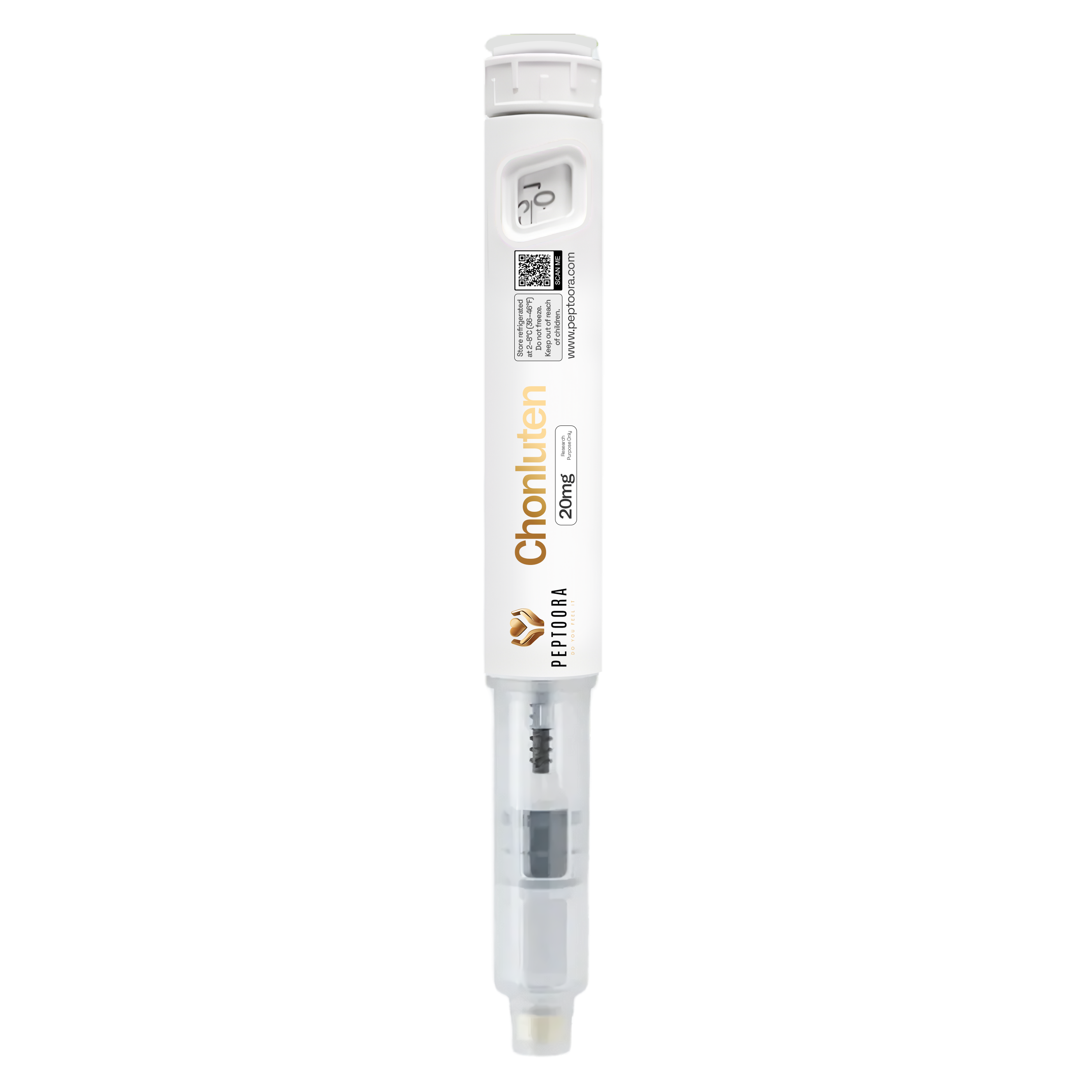
Chonluten (Glu-Asp-Gly) | Pen
Chonluten (Glu-Asp-Gly) is a bioregulator positioned for controlled research settings where cartilage and connective-tissue homeostasis is being studied in relation to collagen/ECM organization, inflammation-linked transcription signaling, and cellular repair dynamics.
Supports
- ECM organization readouts (collagen/proteoglycan-linked markers) in cartilage-relevant models
- Inflammation-associated transcription activity (e.g., NF-κB-linked outputs) in experimental systems
- Chondrogenic differentiation signaling in MSC-based assay designs
- Matrix remodeling balance (e.g., MMP/TIMP-related endpoints) in vitro
- Cell stress and apoptosis-associated markers in model-dependent studies
Description
Chonluten (Glu-Asp-Gly), also referenced in some literature as the ultrashort tripeptide EDG, is discussed within the broader category of peptide bioregulators—short, sequence-defined peptides explored as tools for modulating gene-expression programs and cellular behavior under controlled experimental conditions.
In cartilage and joint research contexts, ultrashort peptides may be used to frame hypotheses around connective-tissue maintenance, extracellular-matrix turnover, and inflammatory signaling that can impact tissue mechanics. Reported effects are highly dependent on the model system (cell type, tissue context, culture conditions, and endpoints measured) and should be interpreted as research-positioned observations rather than clinical conclusions.
Notably, some sources describe EDG/Chonluten with primary biological targeting in non-cartilage tissues (e.g., respiratory/lung-related contexts), underscoring the importance of defining tissue relevance experimentally when designing cartilage-focused studies.
Clinical Status
Publicly accessible evidence for EDG (Glu-Asp-Gly) is primarily mechanistic and preclinical, including in vitro and animal-model discussions within the ultrashort peptide bioregulator literature. Clinical-grade validation for cartilage outcomes (e.g., well-powered human trials with imaging and functional endpoints) is not established in the open literature, so EDG is best treated as a research reagent for hypothesis-driven work.
Evidence type:
Human RCT ☐ | Observational ☐ | Animal ✔ | In vitro ✔ | Regulatory approval ☐
Mechanism of Action
Ultrashort peptides are described as modulators of gene expression and protein synthesis, with proposed mechanisms spanning transcriptional regulation and epigenetic-like effects in preclinical systems. Within this framework, EDG has been discussed as influencing inflammation-related genes and oxidative-stress–associated pathways in model-dependent settings.
Because cartilage integrity is tightly coupled to extracellular-matrix synthesis and remodeling, research programs may evaluate EDG using endpoint panels that include collagen/proteoglycan markers, matrix remodeling enzymes (e.g., MMP-linked readouts), inflammatory transcription activity (e.g., NF-κB), and apoptosis/stress markers—while controlling for cell lineage and differentiation state (e.g., MSC-to-chondrocyte differentiation assays).
Benefits
-
Connective-tissue hypothesis support (research use):
Positioned for experimental designs assessing cartilage/ECM homeostasis and joint-tissue maintenance pathways. -
Inflammation-linked signaling readouts:
Relevant to studies that monitor transcriptional programs tied to inflammatory regulation as mechanistic endpoints. -
Matrix remodeling evaluation:
Fits assay designs tracking ECM turnover signals (e.g., MMP/TIMP-associated outputs) in vitro. -
MSC/chondrogenesis study context:
Can be incorporated into MSC-based cartilage differentiation frameworks to test model-dependent effects on chondrogenic endpoints. -
Stress-response profiling:
Supports exploratory profiling of oxidative-stress and apoptosis-associated markers in controlled model systems. -
Ultrashort-peptide bioregulator framework:
Aligns with literature describing 2–7 amino-acid peptides as tools for probing transcriptional stability and tissue-specific regulation.
Research Data
| Study/model | Reported effect |
| Review synthesis: ultrashort peptides as gene-expression regulators | Ultrashort peptides (including EDG) are described as modulators of gene expression and protein synthesis in preclinical systems (mechanistic framing). |
| Animal model discussion (induced pathology in rats; gene-expression endpoints) | EDG is described as regulating mRNA expression of multiple genes and inflammatory/oxidative-stress–linked mediators in a rat model (model-dependent reporting). |
| Preclinical inflammation context (reviewed evidence) | Bioregulator peptides are discussed as influencing inflammatory signaling networks and transcriptional stability in experimental systems. |
| Transport/uptake context (POT/LAT carrier literature) | Di- and tripeptide transporters (e.g., PEPT-family) are reviewed as plausible routes for cellular uptake of ultrashort peptides, relevant to experimental exposure design. |
| Peptide bioregulators in regenerative biology (reviewed) | Short-peptide frameworks are linked to regenerative biology hypotheses, supporting structured endpoint selection (ECM, inflammation, cell-state markers). |
| Cartilage repair and regeneration literature (functional peptides) | Functional peptides in cartilage tissue engineering show model-dependent effects on chondrogenesis/ECM endpoints, supporting peptide-centric experimental approaches. |
| Peptide-functionalized biomaterials for cartilage engineering (review) | Peptide motifs are reported to influence cell adhesion, differentiation, and ECM deposition in cartilage-related platforms (contextual support for peptide-based designs). |
| Soft tissue/joint peptide therapy landscape (review) | Peptide approaches for soft tissue/joint contexts are reviewed broadly; emphasizes variability by peptide class and study design rather than universal effects. |
Stack Suggestions
In extended experimental designs, Chonluten (Glu-Asp-Gly) is sometimes paired with:
- RGD-containing adhesion peptides → to probe integrin-mediated cell–matrix interactions in cartilage-relevant systems
- GFOGER (collagen-mimetic) peptide motifs → to support collagen-interaction hypotheses in chondrogenesis/ECM models
- N-cadherin mimetic peptides → to explore cell–cell adhesion signaling as a variable in chondrogenic differentiation designs
Stacks discussed are for experimental design only, not safety/efficacy guidance.
Possible Side Effects
There are no known reports of negative side effects.
Scientific References
- Peptides Regulating Proliferative Activity and Inflammatory Response: A Review of Khavinson Peptides — Review (In vitro/Preclinical)
- Peptides: Prospects for Use in the Treatment of COVID-19 — Review (Human/Preclinical)
- Short Peptides Regulate Gene Expression — Animal/In vitro
- Transport of Biologically Active Ultrashort Peptides Using POT and LAT Carriers — Review (Mechanistic)
- Peptide medicines: past, present, future — Review
- Functional peptides for cartilage repair and regeneration — Review (In vitro/Animal)
- Chondroinductive/chondroconductive peptides and their-functionalized biomaterials for cartilage tissue engineering — Review (In vitro/Animal)
- Peptide-Based Biomaterials for Bone and Cartilage Regeneration — Review (In vitro/Animal)
- Local and Systemic Peptide Therapies for Soft Tissue and Joint Pain: A Review — Review
- Peptide Regulation of Gene Expression: A Systematic Review — Systematic review
Cautions
- For educational and scientific context only; not intended to diagnose, treat, cure, or prevent any disease.
- If you are pregnant, nursing, have a medical condition, or use prescription medication, consult a qualified professional.
- Discontinue use if sensitivity occurs.
Pairs well with
In stock! Ships within 2-6 business days.
Complimentary shipping & returns
Chonluten (Glu-Asp-Gly) | Pen
FAQs
Please read our FAQs page to find out more.
Do I need a prescription to place an order?
No prescription is required to place an order. We recommend professional consultation before using any product where applicable.
Are the pens ready to use?
Our systems are designed for convenience and consistency. Product-specific handling and storage guidance is provided with each order.
Are these products intended to diagnose, treat, cure, or prevent disease?
No. Products are not intended to diagnose, treat, cure, or prevent any disease.
When will my order be shipped?
Orders are typically dispatched within 2–4 business days, subject to product availability and verification. Once shipped, delivery time depends on your destination and carrier.
How should I store products after delivery?
Store products according to the label and included guidance. Some products may require refrigeration after opening. Improper storage can impact product integrity.